

Real Estate Investment Trust (REIT)
What Is a Real Estate Investment Trust (REIT)?
A Real Estate Investment Trust (REIT) is a company that owns, operates, or finances income-generating real estate properties. In simple words, a REIT allows ordinary investors to invest in large commercial properties — such as office buildings, shopping malls, hotels, warehouses, and data centres — without actually buying or managing the property themselves. Just like you buy shares of a company on the stock exchange, you can buy units of a REIT on NSE or BSE and earn regular income from it. REITs were introduced in India by SEBI to make real estate investment accessible to every type of investor, not just the wealthy.

For example, if you invest in an Embassy Office Parks REIT — one of the largest listed REITs in India — you become a part-owner of premium office buildings located in major Indian cities like Bengaluru, Mumbai, and Pune. These properties are rented to large companies, and a significant portion of the rental income is distributed to REIT investors as dividends on a regular basis. This means you can earn income from real estate without owning a physical property, dealing with tenants, or managing maintenance. According to SEBI guidelines, REITs in India are required to distribute at least 90% of their net distributable cash flow to unit holders, making them an attractive source of regular income for investors.
Today, more and more Indian investors are searching for information about what is REIT in India, how to invest in REIT, and the best REIT to invest in India because REITs combine the benefits of real estate income with the convenience of stock market investing. There are currently three major listed REITs in India — Embassy Office Parks REIT, Mindspace Business Parks REIT, and Brookfield India Real Estate Trust. Each of these REITs owns and manages large commercial real estate portfolios. Understanding how REITs work is the first step towards diversifying your investment portfolio with real estate exposure at an affordable cost. This complete guide by The Digi Investor will help you understand everything about REITs in India — from types and benefits to risks and how to invest.
1. How Does a REIT Work in India?
Simple explanation of how REITs collect rent, manage properties, and pay dividends to investors in India.
A REIT works by pooling money from many investors and using that money to buy, own, and manage a portfolio of income-generating real estate assets. In India, REITs are listed on the stock exchange, which means you can buy and sell REIT units during market hours just like shares. The REIT is managed by a professional management team that handles all aspects of property management — from finding tenants and collecting rent to maintaining buildings and managing finances. This professional management removes the burden of property ownership from individual investors.
The income of a REIT comes primarily from rents paid by tenants who occupy the commercial properties owned by the REIT. For example, a large IT company may pay monthly rent to occupy floors in an office building owned by an Embassy REIT or Mindspace REIT. This rental income, after deducting management expenses, is distributed to REIT unit holders as dividends. According to SEBI regulations, Indian REITs must distribute at least 90% of their net distributable cash flows to investors every six months. This makes REIT dividends one of the most consistent sources of passive income available to retail investors in India. The NAV (Net Asset Value) of a REIT unit changes based on the market value of the properties it holds and the overall demand and supply for REIT units on the stock exchange. Understanding how a REIT works helps investors make smarter decisions about how to invest in REIT and earn both rental income and potential capital appreciation over the long term.

— Why REITs Are Different From Physical Real Estate —
Buying physical real estate in India requires a large amount of capital — often in crores of rupees. REITs allow investors to start with much smaller amounts. In India, the minimum investment in a REIT through SIP on some platforms can be as low as a few hundred rupees. Additionally, physical real estate is illiquid — you cannot sell a part of your house in minutes. REIT units, however, are listed on NSE and BSE and can be bought or sold any time during market hours, providing complete liquidity to the investor.
Important Points- Reits Pool Investor Money To Buy And Manage Commercial Properties.
- Reit Units Are Listed On Nse And Bse And Can Be Traded Like Shares.
- Sebi Requires Indian Reits To Distribute At Least 90% Of Net Income.
- Reit Income Comes From Rents Paid By Tenants Of Commercial Properties.
- Professional Management Handles All Property Operations For Investors.
- Reits Offer Real Estate Exposure Without Buying Physical Property.
- Reit Units Can Be Bought And Sold Any Time During Stock Market Hours.
2. Types of REITs Available for Investment in India
Office REITs, Retail REITs, Industrial REITs, and Residential REITs — all types explained simply for Indian investors.
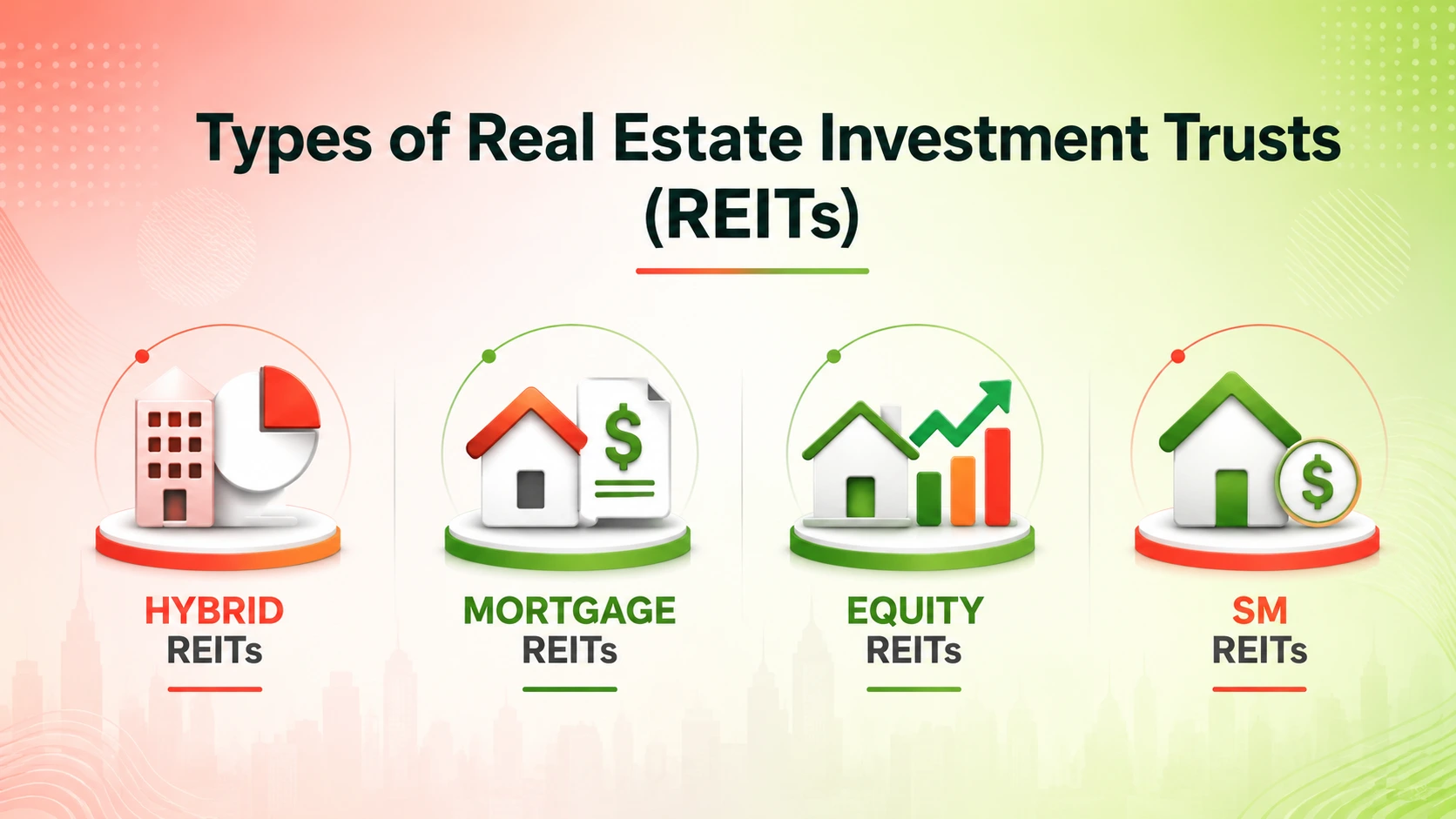
There are different types of REITs based on the kind of real estate they invest in. Understanding the different REIT types helps investors choose the right REIT based on their investment goals, risk tolerance, and preference for income versus capital appreciation. In India, REITs currently focus primarily on commercial office properties, but globally, REITs cover many real estate categories. As the REIT market in India matures, more types of REITs are expected to be listed, offering investors a wider range of real estate investment options.
— Office REITs —
Office REITs invest in commercial office buildings and business parks. In India, all three currently listed REITs — Embassy Office Parks, Mindspace Business Parks, and Brookfield India Real Estate Trust — are office REITs. They own premium Grade-A office spaces that are leased to large IT companies, multinational corporations, and financial institutions. Office REITs in India generate stable rental income because their tenants sign long-term lease agreements, typically ranging from 5 to 9 years. This provides investors with consistent and predictable dividend income, making office REITs the most popular type of REIT to invest in India today.
— Retail REITs —
Retail REITs invest in shopping malls, retail stores, and commercial retail complexes. Though currently not listed in India as a separate REIT category, retail real estate is a growing segment. Globally, retail REITs earn income from rents paid by retailers, restaurants, and entertainment venues operating in malls. In India, investors expect retail REITs to be introduced as the commercial retail market expands in Tier 1 and Tier 2 cities.
— Industrial and Warehouse REITs —
Industrial REITs invest in warehouses, logistics parks, and manufacturing facilities. With the rapid growth of e-commerce in India, demand for large logistics and warehousing spaces has increased significantly. Industrial REITs earn stable income from companies that use these spaces for storage, distribution, and manufacturing. This type of REIT is expected to become increasingly important in India as the logistics sector expands.
 Important Points
- Office Reits Are The Most Common And Listed Reit Type In India Today.
- Embassy, Mindspace, And Brookfield Are India's Three Listed Office Reits.
- Retail Reits Invest In Shopping Malls And Commercial Retail Spaces.
- Industrial Reits Own Warehouses And Logistics Parks For E-Commerce Growth.
- Different Reit Types Suit Different Investment Goals And Risk Levels.
- India's Reit Market Is Expected To Grow With New Types Being Listed.
- Understanding Reit Types Helps Investors Choose The Best Reit In India.
3. Benefits of Investing in REITs in India
Regular dividend income, diversification, liquidity, and professional management — key REIT benefits for Indian investors.
Investing in REITs offers several powerful advantages that make them an attractive option for Indian investors who want exposure to real estate without the challenges of direct property ownership. The biggest benefit of REIT investment is the regular dividend income. Since SEBI mandates that Indian REITs distribute at least 90% of their net distributable cash flows to unit holders, investors can expect consistent quarterly or semi-annual dividend payments. This makes REITs an excellent source of passive income — ideal for retired investors, salaried professionals, or anyone seeking regular cash flow from their investments.
The second major benefit is diversification. By investing in a REIT, your money is spread across many properties in different locations, occupied by multiple tenants from different industries. This diversification reduces the risk of income loss compared to owning a single physical property where one vacant tenant can significantly impact your rental income. Professional management is another major advantage — experienced real estate professionals handle all property-related tasks including leasing, maintenance, renovation, and financial management. Investors do not need any real estate expertise to benefit from REIT investment. Additionally, REITs are listed on the stock exchange, offering complete liquidity — you can sell your REIT units any time during market hours without the lengthy and complex process of selling physical property. For most Indian investors, the best REIT to invest in India is one that combines stable rental income, strong tenant quality, low vacancy rates, and a professionally managed portfolio of Grade-A commercial properties.
 Important Points
- Reits Provide Regular Dividend Income From Commercial Property Rentals.
- Sebi Mandates 90% Distribution Of Net Cash Flow To Reit Investors.
- Reits Offer Instant Diversification Across Many Properties And Tenants.
- Professional Managers Handle All Property Operations On Behalf Of Investors.
- Listed Reits Can Be Bought And Sold Any Time On Nse And Bse.
- Reits Allow Real Estate Investment Without Buying Physical Property.
- Reit Investment Is Ideal For Passive Income Seekers And Retirees In India.
4. Risks of REIT Investment Every Investor Must Know
Market risk, interest rate risk, vacancy risk, and regulatory risk — what every REIT investor in India must understand.
While REITs offer attractive benefits, every investor must also understand the risks involved before making an investment decision. The most common risk associated with REIT investment is market risk. Since REIT units are listed on the stock exchange, their prices can go up or down based on overall stock market sentiment, even if the underlying properties are performing well. A broad market crash can cause REIT unit prices to fall significantly in the short term, even though the rental income from the properties may remain stable. Investors who panic and sell during such periods may incur losses.
Interest rate risk is another significant factor for REIT investors. When interest rates rise, two things happen — the cost of borrowing for REITs increases (reducing profitability), and fixed-income instruments like bonds and FDs become more attractive, causing some investors to shift away from REITs. This can put downward pressure on REIT unit prices. Vacancy risk is also important — if a large tenant vacates a property in the REIT's portfolio, rental income can fall temporarily, affecting dividend payouts. Regulatory risk relates to changes in SEBI guidelines, tax treatment of REIT distributions, or property law amendments that could impact REIT operations. Investors should also consider concentration risk — Indian REITs currently concentrate heavily in office properties in a few cities, making them vulnerable to changes in office space demand, such as the work-from-home trend. Despite these risks, REITs remain a strong long-term investment when chosen carefully and held with patience. Investors should always read the REIT's annual report, understand its tenant profile, and evaluate its occupancy rates before investing.
 Important Points
- Reit Unit Prices Can Fall Due To Stock Market Volatility And Sentiment.
- Rising Interest Rates Can Negatively Impact Reit Profitability And Prices.
- Vacancy Risk Reduces Rental Income When Large Tenants Leave Properties.
- Regulatory Changes By Sebi Or Government Can Affect Reit Operations.
- Indian Reits Are Concentrated In Office Properties In A Few Cities Only.
- Work-From-Home Trends Can Impact Demand For Office Reit Properties.
- Always Check Occupancy Rates And Tenant Profile Before Investing In Reits.
5. How to Invest in REIT in India — Step-by-Step Guide
How beginners can buy REIT units in India through Demat account, broker platform, and step-by-step process.
Investing in REITs in India is simpler than buying physical real estate and can be done entirely online through a trading platform or stock broker app. The first requirement is to have a Demat account and a trading account with a SEBI-registered broker. Popular platforms in India such as Zerodha, Groww, Angel One, HDFC Securities, and ICICI Direct all allow investors to buy and sell listed REIT units during market hours. If you do not already have a Demat account, you can open one online in a few minutes by completing the KYC process using your PAN card, Aadhaar card, and bank account details.
Once your account is active, search for the REIT you want to invest in. Currently, the three listed REITs in India are Embassy Office Parks REIT (ticker: EMBASSY), Mindspace Business Parks REIT (ticker: MINDSPACE), and Brookfield India Real Estate Trust (ticker: BIRET). You can search for these on your trading platform, review their current unit price, dividend history, occupancy rate, and financial performance, and then place a buy order. REIT units are bought and sold in lots — the minimum lot size has been reduced to just 1 unit for all listed Indian REITs after SEBI's 2021 directive, making REIT investment accessible to even small investors. After buying, REIT units are credited to your Demat account, and you start receiving quarterly or semi-annual dividend distributions. Many investors looking for the best REIT to invest in India start by comparing the distribution yield, occupancy rates, and weighted average lease expiry (WALE) of the three listed REITs before making a decision. For truly informed investing in REITs, always read the latest quarterly report and investor presentation published by the REIT management before committing your capital.

— Step-by-Step Process to Buy REIT Units in India —
- Open a Demat and trading account with a SEBI-registered broker like Zerodha or Groww.
- Complete KYC using your PAN card, Aadhaar card, and bank account details.
- Search for the REIT ticker on your broker platform (EMBASSY / MINDSPACE / BIRET).
- Review the REIT's distribution yield, occupancy rate, tenant profile, and financial reports.
- Place a buy order for the number of REIT units you wish to purchase during market hours.
- REIT units are credited to your Demat account after the trade is confirmed.
- Receive regular dividend distributions in your bank account every quarter or half-year.
- Track your REIT portfolio performance and reinvest dividends for compounding growth.
- You Need A Demat And Trading Account To Buy Reit Units In India.
- India Has Three Listed Reits — Embassy, Mindspace, And Brookfield Biret.
- Minimum Lot Size For Indian Reits Is Now Just 1 Unit After Sebi's 2021 Rule.
- Compare Distribution Yield And Occupancy Rate Before Choosing A Reit.
- Reit Dividends Are Credited Directly To Your Bank Account Quarterly.
- Read The Reit's Quarterly Report And Investor Presentation Before Investing.
- Reinvesting Reit Dividends Can Significantly Grow Your Wealth Over Time.
Never Stop Learning About Investing!
Stay up to date with the latest courses, educator articles, quizzes, and market insights from thedigihk.in — your trusted stock market and REIT investment education partner in India.